
Architecture
The single request path — HTTP intake → cached or fresh render → image back — is where most of the interesting logic lives.
Full flow
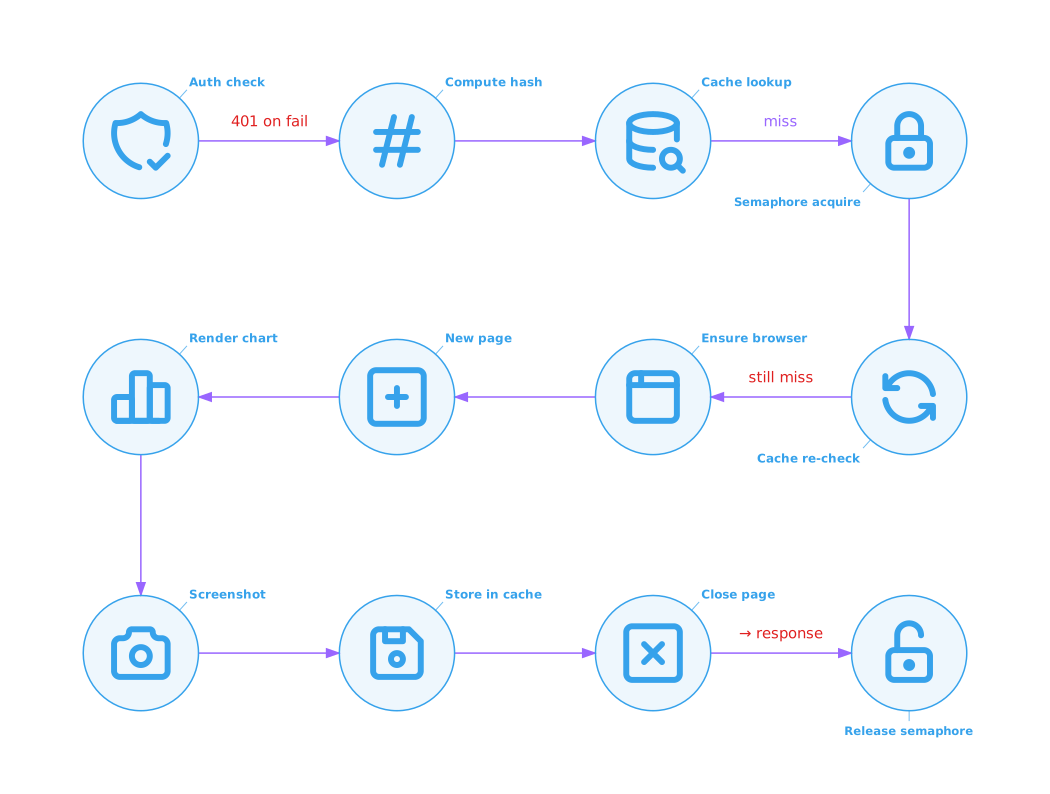
Step-by-step, each box corresponds to the following module:
| Step | Module | Notes |
|---|---|---|
| Auth check | server.ts::checkAuth | 401 if API_KEY set and missing/wrong |
| Compute hash | cache.ts::computeHash | SHA-256(canonical(request))[0:16] — includes engine |
| Cache lookup | cache.ts::getCache | Hit returns image with X-Cache-Hit: true |
| Semaphore acquire | semaphore.ts::acquire | Waits if active == CONCURRENCY (default 8) |
| Cache re-check | cache.ts::getCache (again) | A racing request may have finished while we waited |
| Engine dispatch | renderer.ts | Branch on engine: skia (default, in-process) or browser (Chromium) |
| Store in cache | cache.ts::setCache | Evicts oldest if at CACHE_MAX_ENTRIES |
| Release semaphore | semaphore.ts::release | Wakes next queued render, if any |
Engine dispatch
Once a semaphore slot is held, the renderer branches on the requested engine:
skia (default) — renders entirely in-process:
| Step | Notes |
|---|---|
| Build canvas | Native Skia canvas via skia-canvas, no browser |
| Render chart | Chart.js + bundled plugins (imported from npm) draw onto it |
| Encode | canvas.toBuffer(...) → PNG/JPEG bytes |
browser — renders through headless Chromium:
| Step | Module | Notes |
|---|---|---|
| Ensure browser | renderer.ts::ensureBrowser | Launches puppeteer if not already running |
| New page | b.newPage() + schedulePageCleanup | Safety-net timer force-closes the tab if we leak it |
| Render chart | template.ts::buildHtml + page.goto(dataUrl) | Waits for window.__chartRendered === true; collects window.__chartMessages |
| Screenshot | container.screenshot({ type, quality }) | Buffer with PNG/JPEG bytes |
| Close page | clearPageCleanup + page.close() | Releases the browser tab |
The response carries the image plus X-Cache-* headers and X-Chart-Messages if Chart.js emitted any warnings.
Key design choices
Two engines, one render contract
skia and browser produce the same RenderResult shape and share the cache, semaphore, and plugin set — callers pick per render and the rest of the pipeline is engine-agnostic. skia is the default because it needs no browser (fast, small footprint, nothing to launch); the 35 built-in examples render in ~1.5 s total on it. browser exists for exact real-browser pixel parity and DOM-dependent behavior (e.g. chartjs-plugin-zoom, which is not bundled into the skia engine). The two engines cache independently because computeHash includes engine in its canonical input.
The cache is deliberately coarse
computeHash canonicalizes by JSON-stringifying a stable object shape — {chart, width, height, devicePixelRatio, backgroundColor, format, quality}. That means:
- Different key ordering in
chartdoes not affect the hash (JSON.stringify doesn't sort keys, but the caller submitting the same logical JSON object will almost always serialize it the same way; in practice this is good enough). - Any change in dataset values, however small, produces a different hash.
For pathological hash churn, disable the cache (CACHE_MAX_ENTRIES=0).
The semaphore is independent of the cache
A cache hit does not acquire the semaphore — we return the cached buffer immediately. This keeps repeated identical requests from consuming browser tabs.
One browser, many pages (browser engine)
The next three subsections describe the browser engine only. The default skia engine launches nothing — no browser, no pages, no CDN fetches.
browser is a module-level singleton. Each render gets its own tab (b.newPage()). On browser.on('disconnected') we null the reference so the next request re-launches. Tabs are time-bound: if a render exceeds PAGE_TIMEOUT_SECONDS, the cleanup timer force-closes the tab — no orphaned-page leak on hung renders.
Chromium runs with --no-sandbox
Required for running as root inside Docker (without it, Chromium refuses to start). If you're running chartjs2img outside a container as root, you already have bigger problems.
The HTML template is static
template.ts::buildHtml produces a single HTML document containing every plugin's CDN <script> tag, inline CSS, and an IIFE that:
- Registers plugins that don't auto-register (datalabels, chartjs-chart-geo).
- Forces animations OFF (so
page.screenshotcaptures a stable frame). - Wraps
console.warn/console.errorto push intowindow.__chartMessages. - Creates the
Chartinstance inside try/catch; stores errors onwindow.__chartError. - Sets
window.__chartRendered = trueso the renderer knows to screenshot.
This template is what makes "render any Chart.js config" tractable — a single page init covers every chart type and every plugin we bundle.
Plugins are CDN-loaded at page init (browser engine)
On the browser engine we do not bundle Chart.js plugins into the Node-side JavaScript. They're fetched from jsdelivr inside Chromium on every page load. That has two implications:
- First render after a browser cold-start is slower (network round-trips).
- Offline operation requires a local mirror (nginx serving the same paths, or Puppeteer's request interception pointing at a cache dir).
Upside: upgrading a plugin is a one-line change in template.ts with no rebuild.
The skia engine takes the opposite approach: Chart.js and every bundled plugin are imported from npm and run against the native Skia canvas in-process, so it works fully offline with no CDN dependency.
What isn't in the flow
- No database. The cache is in-memory; restarts lose it.
- No authentication state. Every request carries the key or doesn't.
- No WebSocket / SSE. Just HTTP 1.1 request/response.
- No multi-process rendering. Scale horizontally by running multiple instances behind a load balancer. The cache isn't shared between instances (by design — a CDN is the right layer for that).
Concurrency tuning knobs
| Env var | Default | What changes |
|---|---|---|
CONCURRENCY | 8 | Max semaphore slots — i.e., simultaneous browser tabs |
PAGE_TIMEOUT_SECONDS | 60 | How long a single render can run before the tab is force-killed |
CACHE_MAX_ENTRIES | 1000 | LRU capacity |
CACHE_TTL_SECONDS | 3600 | Per-entry TTL |
See Env vars (HTTP server) and Env vars (CLI) for the user-facing docs.